
Wine storage · 6 min read
Why a Sub-Zero wine column drifts warm in Santa Clara
A Sub-Zero wine column is the quiet member of the kitchen until the day a reds zone reads 61 instead of 55, or the lower drawer sweats and the labels start to lift. In Santa Clara — where a wall of glass on a south-facing Rivermark great room can push afternoon heat right at a built-in, and a serious cellar collection is often the most valuable thing in the house — a couple of degrees of drift is worth taking seriously before it costs you a vintage.
This is a look at what actually goes wrong inside a Sub-Zero wine unit, why the failures show up the way they do here, and how to read the difference between a quick fix and a sealed-system job.
Dual zones, and why one half drifts
Most Sub-Zero wine columns run two independently controlled temperature zones so reds can hold near the high 50s while whites and sparkling sit cooler below. Each zone leans on its own thermistor — a small temperature sensor — feeding the control board, plus a damper or a dedicated evaporator circuit that meters cold air into that half. When one zone alone drifts warm while the other stays dead-on, the sensor or that zone's airflow control is the usual culprit, not the compressor. A thermistor that reads high tells the board the zone is colder than it really is, so the board stops calling for cooling and the wine slowly warms. That single-zone pattern is the most common wine-unit complaint we see, and it is one of the more bounded repairs.
When the whole cabinet won't hold cold
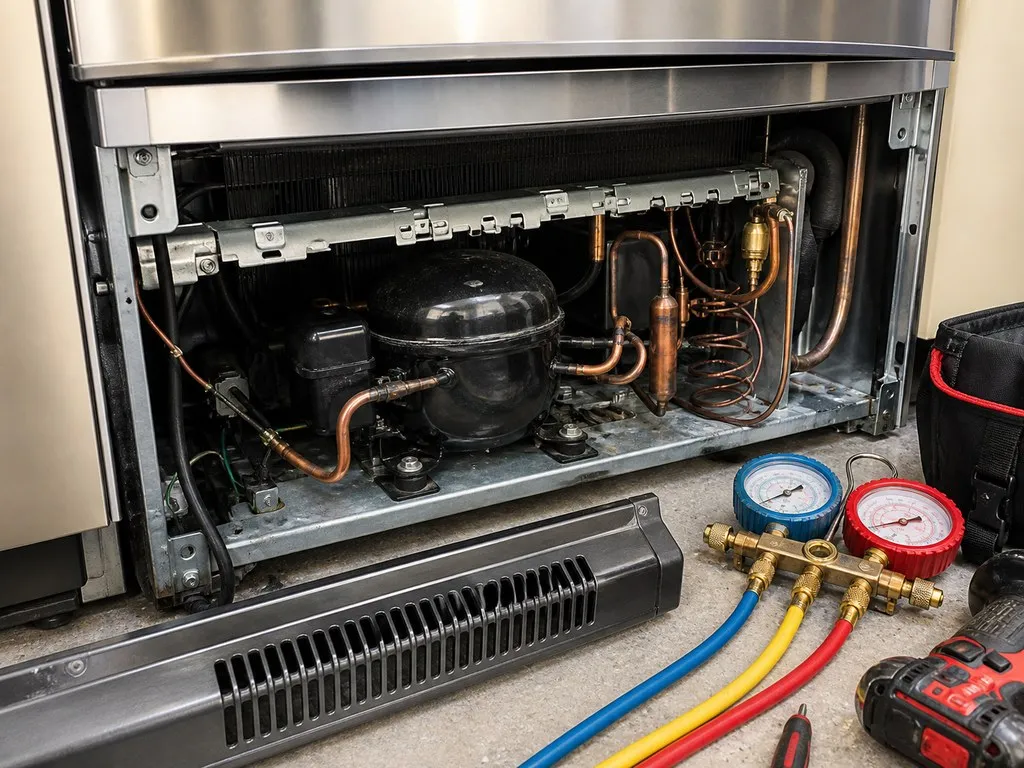
If both zones climb together, look past the sensors to the sealed system and the airflow path. A Sub-Zero wine unit uses the same sealed refrigeration architecture as the built-in refrigerators — compressor, condenser, evaporator and a precise refrigerant charge. The most preventable failure here is a condenser choked with dust and pet hair: a loaded condenser cannot reject heat, the compressor runs longer and hotter, and the cabinet can no longer pull down on a warm Santa Clara afternoon. A stalled evaporator fan does the same thing from the cold side, starving the zones of moving air. Genuine sealed-system trouble — a slow refrigerant leak or a tired compressor — is rarer, but it announces itself: long run times, warm-to-the-touch sides, and a unit that never quite reaches setpoint.
Seals, glass and the things that disturb the bottle
Two failures are specific to wine storage. The door is UV-tinted glass, and its gasket and seal do real work; a gasket that has gone hard or a UV seal letting warm room air bleed in shows up as condensation on the inside of the glass and a zone that fights to hold temperature, especially against the humidity that rolls in off the bay. The other is vibration. Wine wants stillness so sediment stays put, and a worn compressor mount or an out-of-balance fan transmits a faint buzz into the racks that, over months, unsettles a cellar you have been laying down for years. Both are fixable, and both are easy to mistake for 'the unit is just getting old.'
Repair or replace, honestly
A Sub-Zero wine column is built to be serviced, and the economics usually favor repair. A thermistor, a damper, an evaporator fan, a door gasket or a condenser cleaning are all straightforward fixes with genuine OEM parts — small money against a cabinet that protects thousands in bottles. We test the suspected part before replacing anything, so you are not paying to swap a board when a $40 sensor was the fault. Replacement only enters the conversation when a sealed-system repair on a very old unit approaches the cost of a new column, and even then we will tell you plainly rather than steer you toward the bigger ticket.