
Decode the sound by where it's coming from
Sub-Zero Making Noise Repair in Santa Clara
A built-in that has started to buzz, rattle, hum, click or grind is telling you which part is tired — and the location of the sound usually names the cause. We map it by zone: the condenser and its fan up top, the evaporator fan behind the back wall, the compressor at the base, and the water valve on the ice side. We diagnose on site, fix it with genuine OEM Sub-Zero parts, and waive the $89 service call when you book the repair — all under a 365-day labor warranty. Call (650) 800-5431 or book online.
Quick answers
Sub-Zero repair in Santa Clara — quick answers
My Sub-Zero suddenly got loud — is that dangerous?
Not immediately, but a new noise is worth diagnosing. A rattle from the top grille is usually a debris-fouled condenser fan, while a deep knock or grind at the base can mean a failing compressor mount — very different urgencies. We tell you which on site.
What's the loud humming or droning from my built-in?
A hum that has grown louder than the unit's normal background often traces to a heat-soaked condenser making the compressor labor, or a fan bearing starting to dry out. Cleaning and a fan check resolve many of these before any major part.
Why does my Sub-Zero buzz only when it makes ice?
A buzz that lines up with an ice fill is the water inlet valve chattering against a restricted or scaled supply line — common in Santa Clara's hard water. It's a contained repair, not a compressor problem.
Is a clicking sound something to worry about?
Light, periodic clicks are often normal defrost timing or relays. Persistent rapid clicking with poor cooling can be a start relay or compressor struggling to run. Note when it clicks and call (650) 800-5431 so we can match the pattern.
Rattle from the top grille
A whir or rattle up high is the condenser fan — usually a blade fouled with dust and pet hair, or a bearing starting to wear. Often a clean-and-check fix.
Tick or rub behind the back wall
Sound from inside the cabinet is the evaporator fan catching frost from a defrost fault, or a tired fan bearing. We trace the airflow, not just quiet it.
Knock or grind at the base
A hard knock or grind from the floor of the unit points at the compressor mounts or the compressor itself. We confirm electrically before any sealed-system talk.
Buzz when it makes ice
A buzz or hammer timed to an ice fill is the water inlet valve against a scaled or restricted line — a contained repair, not a compressor issue.
Loud, steady droning
A hum louder than the unit's normal background is often a heat-soaked condenser making the compressor labor. Cleaning airflow frequently restores quiet.
Rapid, repeated clicking
Periodic clicks are normal; fast repeated clicking with weak cooling can be a start relay or compressor straining. We match the pattern to the part.
Noise by location, likely cause and what we do
How we decode a built-in noise across Rivermark open kitchens, Old Quad classics and the SCU area.
| Where it's coming from | Likely cause | What we do |
|---|---|---|
| Top grille — rattle or whir | Condenser fan: debris or bearing | Clean and balance the fan, verify the bearing, replace OEM motor if needed |
| Back wall — tick or rub | Evaporator fan or defrost frost | Diagnose the defrost circuit, clear frost, replace the fan as needed |
| Base — knock or grind | Compressor mounts or compressor | Test electrically, check mounts, quote sealed-system work only on proof |
| Ice side — buzz or hammer | Water inlet valve, restricted line | Replace valve, clear the scaled supply line, confirm a quiet fill |
| Whole unit — loud droning | Heat-soaked condenser, labored compressor | Deep-clean the condenser, verify airflow, recheck run noise |
| Fast repeated clicking | Start relay or compressor struggling | Test the start circuit, measure the load, replace the failed part |
Compressor and sealed-system work is quoted only after electrical evidence — never as a first guess.
A map, not a guessing game
Where the sound lives tells us what failed
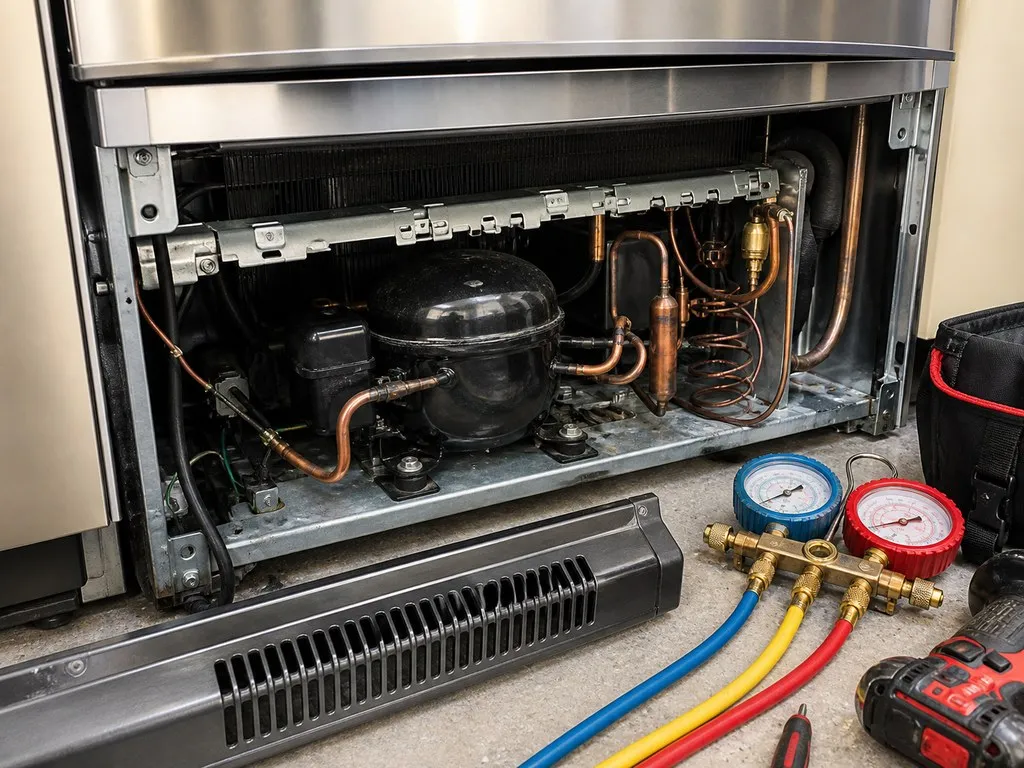
Sub-Zero built-ins are engineered to run quietly, so a new noise stands out — and the most reliable first clue is location, not volume. Up at the top grille sits the condenser and its fan; a rattle or whir from there is usually a fan blade fouled by dust and pet hair, or a fan motor whose bearing is wearing. Behind the fresh-food back wall is the evaporator fan; a tick, flutter or rubbing sound from inside the cabinet often means the blade is catching frost from a defrost fault, or its bearing is going.
At the base lives the compressor; a smooth low hum there is normal, but a hard knock, a metallic rattle, or a grind that rises as it runs points at the compressor mounts or the unit itself. On the ice side, a buzz or hammer that coincides with a fill is the water inlet valve reacting to a restricted line. Name the zone and you have narrowed six possible parts to one or two — which is exactly how we work the call instead of swapping components on a hunch.

Step by step
What to check before you call
Four quick checks that sometimes quiet a built-in — and always help us arrive with the right part.
- 1
Locate the sound
Open the doors and listen at the top grille, the back wall inside the cabinet, and low at the base. Pinning the zone — top, inside, or bottom — is the single most useful thing you can tell us.
- 2
Clean the condenser
Pull the upper grille and vacuum the condenser coil and fan area. A dust-packed condenser makes the fan rattle and the compressor labor; clearing it quiets a surprising share of noise calls on its own.
- 3
Note when it happens
Is the noise constant, or does it rise during a defrost or line up with an ice fill? A buzz tied to ice points at the water valve; a drone that never stops points at airflow or the compressor.
- 4
Check the unit sits level
A built-in nudged out of level or touching the cabinet can transmit a buzz into the surrounding millwork. Confirm it's seated square; if the sound is structural rather than mechanical, that's worth knowing before we arrive.
If the noise comes with poor cooling, a burning smell, or a unit that won't restart, stop running it and call (650) 800-5431. Forcing a struggling compressor can turn a fan-motor job into a sealed-system one.
Why Santa Clara homes hear it sooner
Open great-room kitchens and aging Old Quad units
Two things about Santa Clara's housing make a new built-in noise both more noticeable and more telling. The newer Rivermark townhomes and the north-side remodels near Levi's Stadium favor open layouts where the kitchen flows straight into the living space — there's no wall to absorb a drone, so a fan or compressor that has begun to complain carries across the room and into every conversation. Owners there tend to catch problems early, which is the best time to fix them.
Older Old Quad and Forest Park built-ins tell a different story. Many are 15 to 25 years old, and on a unit that age a brand-new noise frequently signals genuine end-of-life wear — a condenser fan motor, a compressor mount, or a start component reaching the end of its service life. We separate the cheap, common noises from the ones that warn of a larger failure, clean and verify the condenser and fans first, and only talk about a compressor once the evidence points there. Catching a worsening noise early on these aging units often turns a major job into a modest one.
Noise repair price ranges
Estimated ranges for planning; you approve a firm quote before any work begins.
| Repair | Estimated range | Typical time |
|---|---|---|
| Diagnostic / service call | $89 | 45–90 min |
| Condenser fan clean / replace | $200–$520 | 1–2 h |
| Evaporator fan / defrost | $350–$750 | 1–3 h |
| Water inlet valve | $220–$520 | 1–1.5 h |
| Compressor / sealed system | $1,450–$3,600 | 2–6 h + parts |
$89 service call waived with repair. Final quote depends on model, parts and cabinet access.
Related Santa Clara repair guides
Reviews
What Santa Clara homeowners say
Our Rivermark kitchen is wide open, so when the built-in started droning you could hear it from the couch. The tech found a heat-soaked condenser and a worn fan bearing, cleaned it out and replaced the fan motor with an OEM part. Quiet again, and the $89 came off when I booked the repair.
Our 20-year-old Sub-Zero in the Old Quad picked up a knock at the base. I feared the worst, but they tested it electrically and found hardened compressor mounts rather than a dead compressor. Replaced them, far cheaper than I expected, and backed by the year labor warranty.
A loud buzz hit every time the ice maker filled in our Forest Park home. Turned out to be the water inlet valve fighting a scaled line. They swapped the valve, cleared the supply, and confirmed a quiet fill before leaving. Honest diagnosis, fair price.
Our built-in near the SCU area developed a rattle from the top. The technician pulled the grille, deep-cleaned a filthy condenser and checked the fan — no part needed. He could have sold me something and didn't. Genuine, and the cooling improved too.
FAQ
Frequently asked questions
Why is my Sub-Zero suddenly so loud?
A built-in that was quiet and is now loud has usually developed wear in one moving part, and the location of the sound names it. A rattle from the top grille is the condenser fan, a tick from the back wall is the evaporator fan, a knock at the base is the compressor or its mounts, and a buzz timed to an ice fill is the water valve. We listen by zone on site, then confirm the cause before replacing anything, so you are not paying to swap parts on a guess.
Which Sub-Zero noises are normal and which aren't?
A low background hum from the compressor, a soft whoosh from the evaporator fan, an occasional gurgle as refrigerant settles, and a periodic clunk as the ice maker harvests are all normal. What deserves attention is a noise that is new, steadily getting louder, or coming from a unit that used to run silently. Those changes are the early signal of a bearing, a mount, or a valve beginning to fail, and they are cheapest to fix when caught early.
Can a noisy Sub-Zero just be a dirty condenser?
Often, yes. A condenser packed with dust and pet hair makes the fan rattle as the blade catches debris and forces the compressor to run longer and louder to shed heat. In Santa Clara homes with pets or near construction dust, a deep condenser clean and a fan check quiets a large share of noise calls and also improves cooling, frequently with no part needed at all.
My built-in buzzes when it fills with water — what is that?
That buzz is the water inlet valve vibrating as it opens against a restricted or scaled supply line, and it lines up with each ice or water fill. It is one of the more contained noise repairs. In Santa Clara's hard water the supply path scales over time, so we replace the valve and clear or replace the line, then confirm the fill runs quietly. It is not a compressor or sealed-system problem.
Is a grinding or knocking noise a sign the compressor is dying?
It can be, but not always. A hard knock or grind from the base can mean the compressor mounts have hardened and are transmitting vibration, which is a far smaller repair than the compressor itself, or it can mean the compressor is genuinely failing. We measure the start circuit and the electrical load before condemning a sealed system, because the cheaper fault is common and worth ruling out first.
How much does a noise repair cost in Santa Clara?
Most noise repairs fall between $200 and $750 depending on the part, whether that is a condenser fan, an evaporator fan, a defrost component or a water inlet valve. Compressor and sealed-system work runs higher and is quoted only after electrical proof. The $89 service call is waived when you book the repair, and you approve a firm quote before any work begins.
Should I keep running a noisy Sub-Zero?
If it is still cooling normally and the noise is a mild rattle or hum, it is usually fine to run until we arrive, though a worsening sound is best not ignored. If the noise comes with poor cooling, a burning smell, or a unit that struggles to restart, stop running it and call us, because forcing a straining compressor can turn an inexpensive fan or relay job into a sealed-system replacement.
What does the 365-day labor warranty cover on a noise repair?
Every noise repair we perform carries a full 365 days on the labor. If the fault we corrected, whether a condenser fan, an evaporator fan, a relay or a water valve, returns within the year, we come back and make it right at no labor charge. It is the same warranty across condenser and sealed-system work, backed by our 4.9/5 rating from 1,503 reviews.

Sub-Zero making noise? Book a Santa Clara visit
A new rattle or hum rarely fixes itself. Talk to an independent Sub-Zero specialist now — $89 service call, waived with your repair, plus a 365-day labor warranty. Call (650) 800-5431 or book online.