
Local guide · 6 min read
Santa Clara's hard water and why your Sub-Zero ice maker quits first
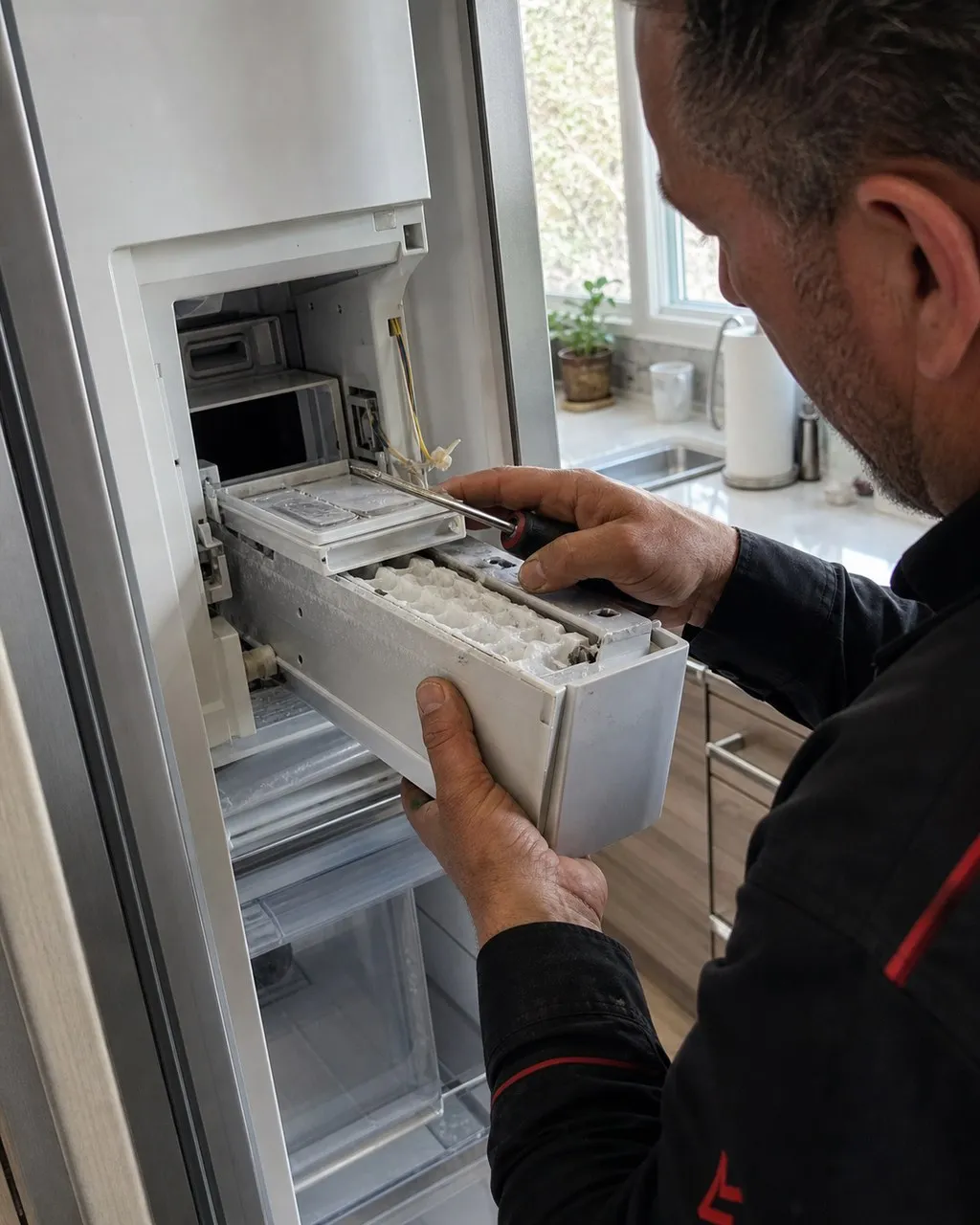
Of all the Sub-Zero parts in a Santa Clara kitchen, the ice maker is the one that feels the local water first. The supply across much of the valley runs hard — mineral-rich — and that mineral content has a habit of settling exactly where an ice maker can least afford it.
If your built-in has started making cloudy, hollow or shrinking cubes, or it's gone quiet altogether, the cause is usually scale, not a dead module. Here's what's happening and how to slow it down.
What hard water does inside the unit
Every fill cycle leaves a faint mineral film behind. Over months that film hardens into scale on the fill tube, the inlet valve screen and the mold itself. A partly blocked valve underfills the mold, so cubes come out small and hollow. Scale on the mold keeps cubes from releasing cleanly, which is when you start hearing the harvest arm strain or the unit stop cycling. None of that is the electronics failing — it's the plumbing path silently narrowing.
The water filter is your first line of defense
The in-unit water filter is doing more work in Santa Clara than it would in a soft-water town, and it loads up faster as a result. Changing it on schedule — roughly twice a year here rather than the once a year the manual assumes — keeps a lot of mineral out of the valve and mold. A neglected filter doesn't just hurt taste; it accelerates the scaling that eventually stalls the whole ice system.
When it's past a filter change
If the cubes are already small or the maker has stopped, a filter swap alone won't reverse scale that's set. That's a descale of the fill path and inlet valve, and sometimes a valve or mold replacement with a genuine OEM part. We test water flow and the harvest cycle before replacing anything, so you're not paying to swap a module that just needed its plumbing cleared.
A habit that helps
If your kitchen sits empty for a stretch — a long trip, a quiet season near Levi's Stadium off-weeks — old ice sublimates and concentrates minerals in the bin. Tossing the first bin of ice after you're back, and after any service, clears the stale, mineral-heavy cubes and lets the unit rebuild a clean batch.